

I was nearing the end of my pregnancy with my son and having a hard time. I had had intercostal neuralgia since 20 weeks, anxiety that wouldn’t quit, and a sense that I couldn’t eat or even breathe. It felt like my baby was stuck in the way. By that time I also had right sided flank pain and inhibited urination. I was suggesting perhaps we should look at my kidneys, and my midwife said to me: “stop being your own doctor.”
My son was born after an 84 hour labor in which I dilated to only 5cm. I asked for a c-section. The anxiety from my pregnancy turned to despondency postpartum. I’m not sure if I reached a turning point because of this or if a turning point gave me the energy to ask the powerful question: what if I had been my own doctor?
My TCM training had left me confused throughout my pregnancy. When I looked at myself I saw patterns stacked on patterns and nothing fit quite right. I looked up my notes from my 6 week gynecology class in acupuncture school and found the single class on pregnancy. My notes read: “Do not treat pregnant women without specialty training. Do not use points SP 6, LI 4, UB 60, UB 67, back points, abdominal points, or GB 21.”
So I sought out specialty training. I studied with Sharon Weizenbaum and learned that none of my TCM patterns made sense because we were never even taught about the uterus. How the Ren Mai creates the Bao Mai under the influence of the Heart and Kidney, and the Bao Tai is the complex of the uterus and the fetus. That the fetal qi is hot, and that heat isn’t necessarily pathological. I became aware of a whole universe of women’s physiology that was glossed over in my 6 week course, that I never would have found unless I looked.
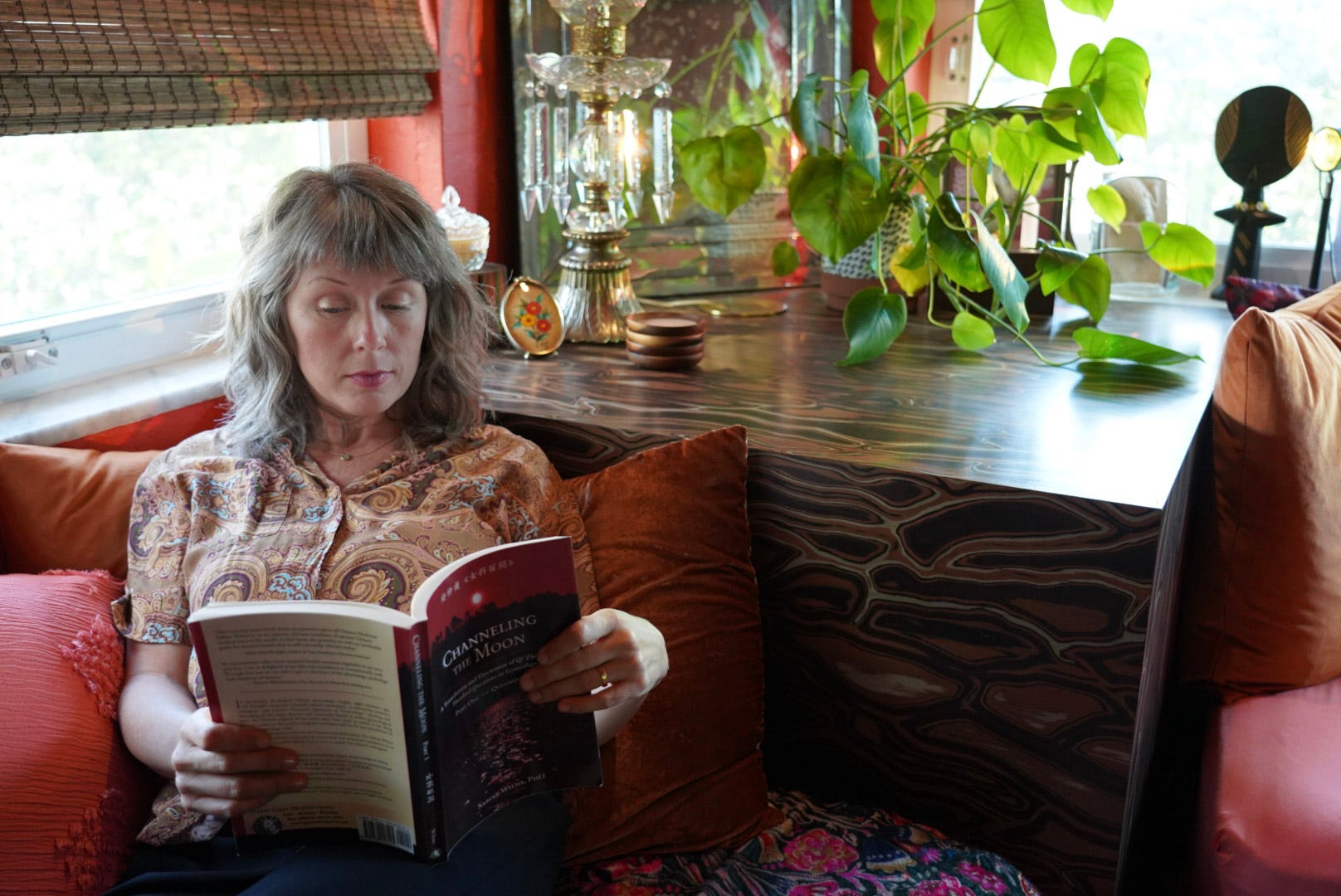
I started reading the classics. I read and committed to memory chapters 20 through 22 of the Jin Gui Yao Lue from the 2nd century, where already physicians were advised to give detailed diagnoses for women’s issues, with whole chapters dedicated to pregnancy and postpartum. I read Sun Simiao from the 7th century and marveled at the richness of diagnosis and treatment for menstruation and leukorrhea. I read Qi Zhongfu, translated by Sabine Wilms, from the 12th century, and noted the cultural veneration of the menstrual cycle at a time when in Europe it was considered a curse. I read Fu Qing Zhu from the 17th century and found my diagnosis.
Fu Qing Zhu described a pattern in pregnancy characterized by lateral costal pain, a wiry pulse, and the sense that the baby has moved up so high it is sitting under the ribs. It includes liver qi stagnation as a starting point, which prevents liver blood from assisting kidney water in nourishing the Bao Tai. It described the pain in my ribs, the anxiety, the sense that my baby was up way higher in my body than seemed possible, why it was so difficult to breathe. The treatment -- open the flow of liver qi, supplement dried liver blood -- would have shifted that sensation I was experiencing at 20 weeks. It also would have likely staved off the kidney infection that went untreated at the end of my pregnancy, which prevented me from having the uterine contractions needed to dilate and birth my baby. The formula was Jie Yu Tang.
All of my symptoms slipped through the cracks in obstetrics, midwifery, and TCM. They were common symptoms of pregnancy, something to endure. Fu Qing Zhu didn’t write them off in his Nu Ke. He explained them with clear logic, and described exactly where they would lead if left untreated. He was right. And his reasoning was clear enough that I could replicate it in my own patients.
When I read this section in Fu Qing Zhu’s Nu Ke, I felt like I had the key. If I had known about pregnancy physiology I could have easily interpreted the pattern. The liver qi stagnation, the spleen deficiency, the blood deficiency -- I could see it all before, but understanding how liver blood and kidney water needed to work together to nourish the fetus would have given me the tools to treat myself. It also would have stopped the progression of pathology to my kidneys, which were so taxed because they were entirely responsible for nourishing my, thankfully, very nourished son.
I should have been my own doctor way before the midwife told me not to be. I needed this knowledge, written by a physician from the 1600s, when I was 20 weeks pregnant. It was immediate -- I knew my practice needed to shift to focus on pregnancy and women’s health.
I would never let a woman with Suspended Fetus go untreated again. It is a pattern marked by what is so often dismissed as common pregnancy symptoms, not worth treating.
I started a new clinic inside a practice that specializes in services and education for pregnant women, Amazing Births and Beyond, run by Dr. Vivian Keeler, a doula, pregnancy chiropractor, and head of HypnoBirthing International. In no time, about a third of my patients were pregnant people who were having supported, comfortable pregnancies and wonderful births. I continue to canvas the classics of Chinese medicine gynecology and will continue to do so, because there are thousands of years of thoughtful ideas preserved in this lineage. Reading descriptions of different patterns often points me to the correct treatment for a current tricky patient. After years of listening to and experiencing positive birth stories, my husband and I found the courage to rewrite our birthing story too. My pregnancy with my daughter was easy compared to my first, and the birth was the most empowering experience of my life.